

Raw signal to brief-ready concepts, in one chain.
Case studyNext Gen IntelligenceVideo 2:40
We built Next Generator, a research intelligence engine, for Team Outrageous, who help brands understand emerging trends among younger audiences. It runs on Claude Sonnet and Claude Opus. It reads a library of 60,000 qualitative research documents and turns a written brief into trends, strategic platforms and creative concepts, each citing the research behind it. Strategists now go from a brief to first concepts in under five minutes, a step that used to take about a week. Built and onboarded in six to eight weeks.
- Client
- Team Outrageous
- Product
- Next Generator
- Category
- Intelligence
- Stack
- Claude Sonnet and Claude Opus, vector database (RAG), secure chat interface
- Time to value
- 6 to 8 weeks, build and onboarding
- Status
- Live
- Updated
Results
Measured on live client briefs.
| Metric | Before | After | Measured over | How measured |
|---|---|---|---|---|
| Brief to first concepts | About a week | Under 5 minutes | Live client briefs | Time to output, alongside feedback from the strategists who use it. |
See it in action
Drop in a brief and watch the engine run an end-to-end creative process powered by real signal, from raw research through to finished concepts.
Read the transcript
From Vimeo’s auto-generated captions, lightly edited.
What it is
So what we have here is a tool that we’ve created for FMCG insight and trend brands. So what they do is they help companies understand what the emerging trends are for younger audiences. So what we’ve built is ultimately something that ingests 60,000 qualitative documents, and then it builds the process based off that company, so they can do it quicker, better, and more in-depth.
Setting up a campaign
So what happens when you log in? You log into a campaign or create a campaign. So here we’ve created Bombo Donuts. They’re a Gen Z. They want to identify what the next Gen Z donut trend is. So the context, they’re gourmet donuts. You put that in. You put who they’d like to target. Fundamentals of the type of product. So if it’s a pizza brand, it has to be a pizza. If it’s a donut brand, it’s a donut. And then the brief, identify this.
Clarifying the brief
So then what we do is we’ve built the tool to then clarify and get clear understanding of what that looks like. So Donna is the name of the research assistant. She comes back, clarifies exactly what they’re looking for. So Crosstown, which is a donut brand on steroids, and then research the target Gen Z influencers and lifestyles that they can then impact.
Trends
So then what Donna does is she identifies 49 trends from those 60,000 documents that are based off 1,357 signals. Then we can get her to create it, or I could do it myself, where we pull them down. So she’s then identified 20 trends that exist. So the first is… or the second is sweet spicy, so you may see the emergence of hot honey everywhere. And then there’s things from flavour trends, to cultural trends, to category trends, to consumer trends, to lifestyle. She goes and pulls all of them. She understands them, and then what she does is we consolidate them into platforms.
Platforms
So platforms are groupings of trends to answer that before an idea. So here she’s identified five platforms. So one is spicy shock therapy, and she creates that against the need state for the user and the end state, and then identifies supporting insights. She’s done that for five platforms.
Ideas and the shortlist
And then what she’ll do is she’ll go and create ideas that sit underneath. And this is learned from this company, the way they create ideas. So ultimately, it creates very similar ideas. I can pick and shortlist the ones I like, or I can add my own, and she’ll go through and do that. And at the end, after I’ve selected them, she will go through that shortlist and reassess it against the original brief to then identify which are the best ideas for this client. So here it’s come up with Chimpanzini Panini, which is a meme energy food form donut. It commits to the name and everything else, and they can lean playfully into it. And then it grades them against the original criteria. It does that and creates multiple ideas.
The result
But what it’s essentially done is it enabled them to streamline the amount of work and time they put into this and do it at so much greater. It’s revolutionary the way it can pull insights for them, identify things, and group them that a human simply couldn’t have done, and it’s changed the way they work with their clients.
What it does
The Next Gen engine takes every piece of research the team has ever commissioned and runs it through a multi-layered creative chain: signals to trends, trends to platforms, platforms to personas, personas to concepts.
Ingests research at scale
PDFs, DOCX, decks and trend reports. Up to 60k qualitative inputs queued as raw signal for the engine to make sense of.
Signal-to-trend synthesis
Cross-cohort patterns surface automatically and cluster into strategic territories. Every claim is cited back to source.
Five living personas
Interests, motivations, tensions, emotional drivers, channels and buying patterns, grounded in real data and tied to the platforms above them.
An end-to-end creative process
A natural-language brief in, finished creative output out. The full chain, without the manual work.
The workflow
A bespoke creative pipeline, from raw signal to finished, brief-ready concepts.
-
Signals captured
60k qualitative inputs ingested.
What happens at this step
- Inputs
- PDFs, DOCX, decks, trend reports, cultural articles, behavioural studies.
- Outputs
- A structured corpus of qualitative signal, secured inside the team workspace.
- Time
- Initial build around 2 weeks; new reports take minutes.
Sixty thousand qualitative inputs queued across PDFs, DOCX, decks and trend reports: cultural trend articles, consumer psychology themes, generational deep-dives, behavioural studies, quantitative and qualitative findings. Every fragment of evidence ingested as raw signal.
-
Trends identified
Patterns across cohorts surface.
What happens at this step
- Inputs
- Tagged signal corpus plus generational insight rules.
- Outputs
- Trend clusters by cohort, behaviour, lifestyle and communication style.
- Time
- One-time build, then live across every brief.
The vector layer clusters meaning across the corpus rather than keywords. Cross-cohort patterns surface without anyone hunting for them: a throwaway line about Gen Z and craft connects to a Millennial nostalgia deep-dive from two years before.
-
Platforms built
Strategic territories defined.
What happens at this step
- Inputs
- Trend clusters plus brand, sector and category context.
- Outputs
- Strategic creative platforms, cited back to the source signals.
- Time
- Around 1 week, validated against the corpus.
Trends are synthesised into strategic creative platforms. Each is a defensible territory grounded in evidence: a tension, a behaviour, a cultural shift the brand can credibly own. A platform with citations behind every claim.
-
Personas modelled
People inside the platforms.
What happens at this step
- Inputs
- Strategic platforms plus persona logic and validation rules.
- Outputs
- Five validated persona profiles, each cited and tied to a platform.
- Time
- 1 to 2 weeks, including validation.
Five personas brought to life inside the platforms: interests, motivations, tensions, emotional drivers, content preferences and decision patterns. Each trait is anchored to a citation and validated against the underlying data before sign-off.
-
Concepts generated
Brief to creative, conversationally.
What happens at this step
- Inputs
- Client brief plus the platform and persona library.
- Outputs
- Several creative concepts, persona-targeted and cited back to source.
- Time
- Under 5 minutes for a first concept set.
A live brief enters through a secure chat interface. The engine reads it, picks the right platforms and personas, and generates concepts grounded in real signal. Strategists refine and pressure-test in plain English, swapping personas and sharpening the angle.
-
Final concepts
Polished, brief-ready output.
What happens at this step
- Inputs
- Selected concepts from the conversational layer.
- Outputs
- Brief-ready creative concepts with full strategic rationale.
- Time
- Minutes per concept.
Selected concepts are taken to a finish: branded, brief-ready, with the strategic rationale and evidence built in. Exported PDFs, opportunity maps, content idea sets and chat transcripts. What used to take a strategist a week of synthesis lands in the team workspace.
The problem
The research was rich. The creative process around it was slow, manual and reinvented for every brief.
Years of commissioned research sat in a shared drive: generational deep-dives, behavioural reports, cultural articles, quant and qual studies. The research itself was excellent. The route from that intelligence to a finished creative concept was not.
Every brief restarted the chain from scratch. Signals were hunted manually, trends synthesised from memory, platforms rebuilt from slides, and personas assembled by whoever could find the right deck. Concepts emerged after a week of work the team had effectively already done, on the same corpus, for a different client.
The research was world-class. The creative process around it couldn’t keep up.
- Years of research reports, locked in PDFs nobody re-read.
- Every brief restarted the creative chain from scratch.
- Brief to first concepts took about a week.
- Strategic rationale was rebuilt by hand for every output.
The solution
A secure intelligence engine that takes raw signal all the way to brief-ready creative output, with trends, platforms, personas and concepts in one conversational chain.
A creative intelligence engine in a secure workspace
The Next Gen engine ingests the team’s entire research corpus, surfaces trends across cohorts, builds strategic platforms, models five fully cited personas, then takes live briefs all the way to finished creative concepts. A conversational interface lets strategists drive the chain in plain English, refining outputs, swapping personas and pressure-testing concepts before they reach a deck.
- Multi-format ingestPDFs, DOCX and decks. Every fragment of research parsed and structured as signal.
- Trend synthesis layerCross-cohort patterns clustered into strategic platforms, cited end to end.
- Five validated personasEach persona grounded in real evidence and tied to a platform, never invented.
- Conversational concept engineBriefs in, concepts out. Refine, swap personas and pressure-test in plain English.
- 60,000Signals
- 24Trends
- 5Platforms
- 5Personas
- 6Concepts
Launch a savings feature for first-time earners.
Lead with control, not saving. The research shows first earners want to see where money goes before they commit to putting it away.
Cited: 14 sources across 3 reportsWant to see the full creative chain?
Arrange a call and we will walk you through the engine live, signals to brief-ready concepts, plus the adjacent intelligence systems we could build for your team.
Arrange a callThe outcome
The team stopped synthesising from scratch and started running briefs through the chain. Brief to first concepts went from about a week to under five minutes, with the strategic rationale built in.
- 5minBrief to first conceptsDown from about a week.
- 60kQualitative documentsThe research library every concept draws on and cites.
- 6–8wksTo build and onboardFrom kick-off to strategists using it on live briefs.
Questions
How long does it take to build an AI research intelligence engine?
Next Generator took six to eight weeks to build, including onboarding the Team Outrageous strategists.
Which AI models does it use?
Claude Sonnet and Claude Opus, with a vector database for retrieval and a secure chat interface on top.
How much faster is it?
Strategists go from a brief to first concepts in under five minutes, a step that used to take about a week.
How was that measured?
By time to output on live client briefs, alongside feedback from the strategists who use it.
More case studies
All our work-
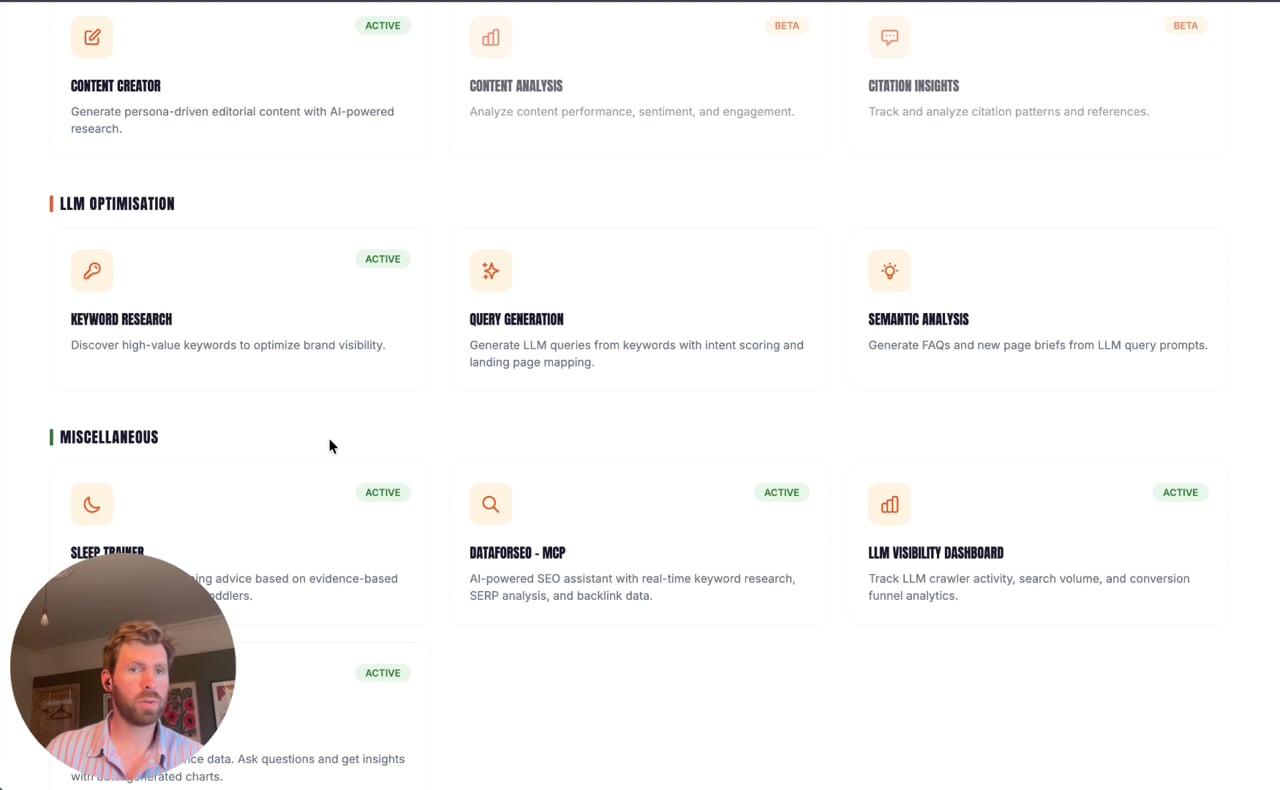
Three days of LLM SEO, in one hour
Case studyWorkflowsVideo 3:10
Keyword research, query generation and a semantic audit, chained into one automated run.
-
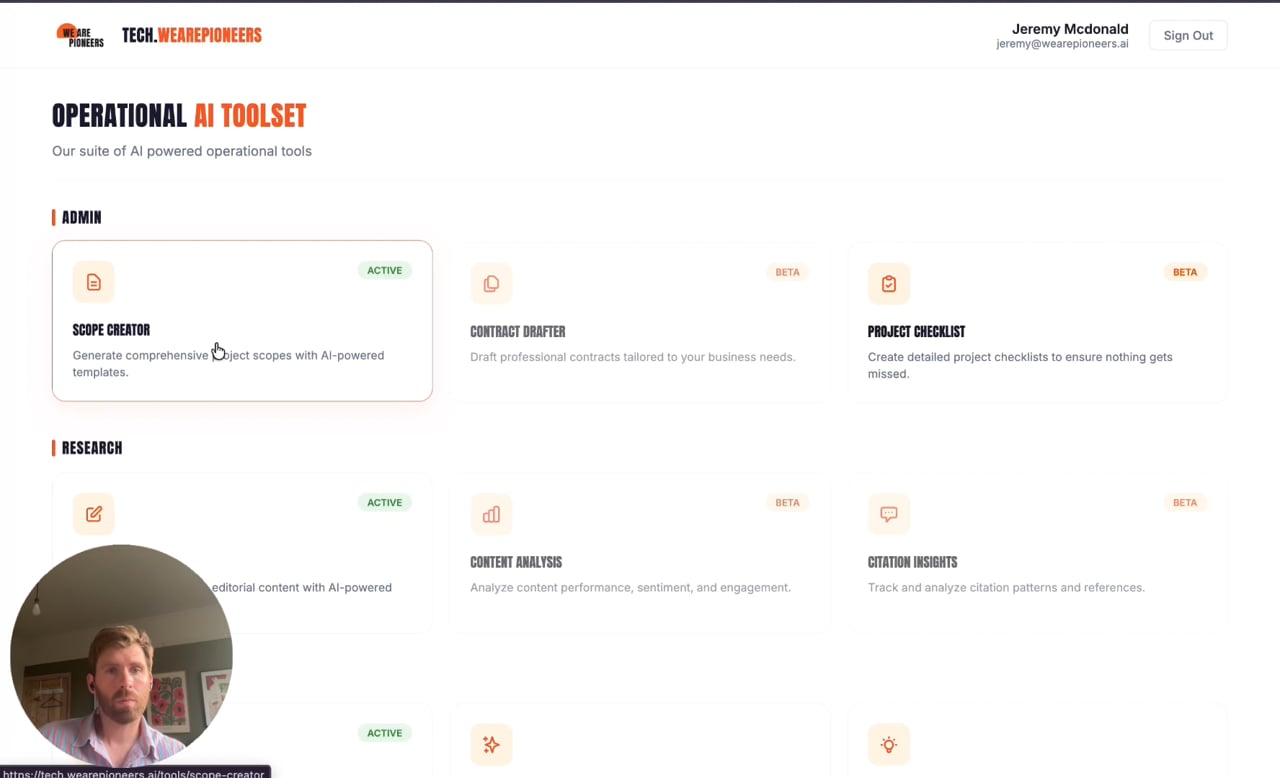
Scope Assistant: a scope in two minutes
Case studyOperationsVideo 1:26
Reads a client call, runs a 22-prompt framework and lands a formatted scope in Drive.
-
Weekly check-inClient callSend the revised media planBook the creative reviewRecap and next steps
Team Agent Assistants: the admin already handled
Case studyOperations
Reads each meeting transcript, reconciles tasks in Trello and drafts the client follow-up in your voice.
Turn raw signals into brief-ready concepts
Get in touch and we will walk you through the full creative chain live, from research ingest to finished concepts.